Downoload PDF
Hatha Yoga in Rishikesh: Meaning, Poses and How to Start
In this article
What is Hatha yoga?
Hatha yoga is a branch of yoga built around physical postures (asanas), breath control (pranayama) and relaxation. “Hatha” is a Sanskrit word that means “force”, and it points to a system of physical techniques. You may also read that ha means sun and tha means moon. That is a popular explanation and not the dictionary meaning of the word.
The classical Hatha texts are medieval. The Hatha Yoga Pradipika, compiled by Svatmarama in the 15th century, is one of the best known. It describes postures, breath control, cleansing practices, mudras and bandhas, and a good part of it is about meditation. Today, when a studio or school offers a “Hatha yoga” class, it usually means a general class built around postures, breathing and relaxation, held at a slower pace than Vinyasa. These are traditional teachings and modern practice, not medical claims.
What a Hatha yoga class looks like
Teachers differ, but a beginner class often follows this pattern:
- Arrival and breathing. A few minutes of sitting and slow breathing to settle in.
- Warm-up. Gentle movements for the neck, shoulders, spine and hips.
- Standing poses. Poses such as Mountain, Tree and Triangle, held for several breaths each.
- Seated and floor poses. Forward folds, hip openers and gentle backbends.
- Breathing practice. Simple pranayama, such as slow breathing or alternate nostril breathing.
- Relaxation. Lying still in Savasana for a few minutes, sometimes followed by a short meditation.
A Hatha class is usually slower than a Vinyasa class. You stay in each pose for a few breaths and have time to learn the alignment.
Hatha yoga poses for beginners
These six poses are common in beginner classes. Move slowly, stay for about 3 to 5 breaths, and stop if anything hurts. Learn them from a qualified teacher if you can.
1. Mountain Pose (Tadasana)
- Stand with your feet hip-width apart and press evenly through both feet.
- Lengthen your spine, relax your shoulders and let your arms hang by your sides.
- Breathe slowly and stay for 5 breaths.
2. Tree Pose (Vrikshasana)
- From Mountain Pose, shift your weight onto your left foot.
- Place the sole of your right foot on your left calf or inner thigh, never on the knee.
- Bring your hands to your chest, find a point to look at and hold for 3 to 5 breaths. Change sides. Keep a wall or chair nearby if you feel unsteady.
3. Triangle Pose (Trikonasana)
- Stand with your legs wide apart, turn your right foot out and reach your right arm along the leg, then place your hand on your shin or a block.
- Open your chest and lift the other arm.
- Read our full guide to Trikonasana, the Triangle Pose.
4. Cobra Pose (Bhujangasana)
- Lie on your stomach with your palms under your shoulders.
- Inhale and lift your head and chest a little, keeping your elbows bent and your shoulders away from your ears.
- Stay for 3 to 5 breaths, then lower down. Skip it or ask a teacher to adapt it if you are pregnant or have a back injury.
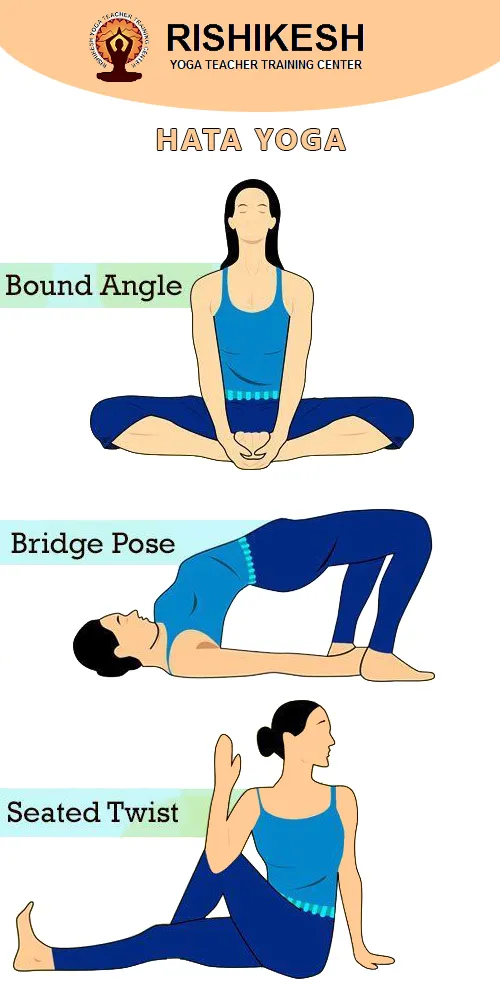
5. Bound Angle Pose (Baddha Konasana)
- Sit with the soles of your feet together and your knees falling open.
- Sit on a folded blanket if your hips are tight and let your knees drop only as far as is comfortable.
- Lengthen your spine and breathe for 5 breaths.
6. Child’s Pose (Balasana)
- Kneel, sit back on your heels and fold forward, resting your forehead on the floor or a cushion.
- Rest your arms alongside your body or stretch them forward.
- Stay for as long as is comfortable. Put a cushion between your thighs and calves if you have knee discomfort.
More simple poses are in our guide to yoga poses for beginners.
Breathing and cleansing practices in Hatha yoga
Breath control (pranayama) is a core part of Hatha yoga. A beginner can start with slow, even breathing through the nose or alternate nostril breathing, done seated and without strain. The classical texts also describe six cleansing practices (shatkarma), such as neti and kapalabhati, and breath retention. These are stronger practices and are best learned directly from an experienced teacher. Skip fast or forceful breathing if you are pregnant, have high blood pressure or a heart or lung condition, or feel dizzy.
Hatha, Vinyasa and Ashtanga: what is the difference?
- Hatha: poses are usually held for several breaths, at a slower pace, with time to learn each one.
- Vinyasa: poses are linked by the breath in a flowing sequence. See our Vinyasa yoga in Rishikesh page.
- Ashtanga: a fixed series of poses practised in the same order. See our 7 days Ashtanga workshop.
Benefits and safety
People who practise Hatha yoga regularly often say it helps them feel more flexible, balanced and relaxed. Yoga is not a treatment or cure for any medical condition. The US National Center for Complementary and Integrative Health describes yoga as generally safe for healthy people when it is practised properly with a qualified teacher. Check with your doctor before you start if you have a health condition, are pregnant or have an injury, tell your teacher about it, and never force a pose.
Learning Hatha yoga in Rishikesh
Rishikesh has many Hatha classes for visitors. If you would like to learn more than a drop-in class, our 15 days Hatha alignment workshop focuses on postures and alignment. You can also study Hatha yoga in depth, together with Ashtanga and Vinyasa, in our 200 hour yoga teacher training in Rishikesh, a 28-day residential course at a Yoga Alliance registered school.
Hatha yoga: frequently asked questions
Is Hatha yoga good for beginners?
Yes. The slower pace and the time spent in each pose make it a common first style. Choose a class for beginners, tell the teacher about any injury or health condition and rest whenever you need to.
How long is a Hatha yoga class?
Most classes last 60 to 90 minutes. At home, 15 to 20 minutes of gentle poses and slow breathing is a good start.
What is the difference between Hatha and Vinyasa yoga?
Hatha classes usually hold poses for several breaths at a slower pace. Vinyasa links the poses into a flowing sequence with the breath.
What does Hatha mean?
It is a Sanskrit word that means “force”. The idea that ha means sun and tha means moon is a popular explanation and not the meaning of the word.
Can I learn Hatha yoga in Rishikesh as a beginner?
Yes. Many schools in Rishikesh offer beginner classes and short courses. Ask about the teacher’s training and class size before you book.
Sources and further reading
- Hatha yoga (Wikipedia): the meaning of the word, the classical texts and the modern use of the term.
- Yoga: What You Need To Know (NCCIH): safety and what research does and does not show.
This guide was written by the Rishikesh Yoga Teacher Training Center team. It describes traditional yoga teachings and is not medical advice.
Ready to train in Rishikesh?
28-day 200 Hour Yoga Teacher Training at a Yoga Alliance Registered Yoga School. Stay and meals from $750.
View dates and feesAsk us on WhatsApp